The Momentum Engine: how independent artists actually build momentum
No blueprint, no guru promises. A ten-part guide to the engine behind every independent music career, and how to run yours on zero budget.
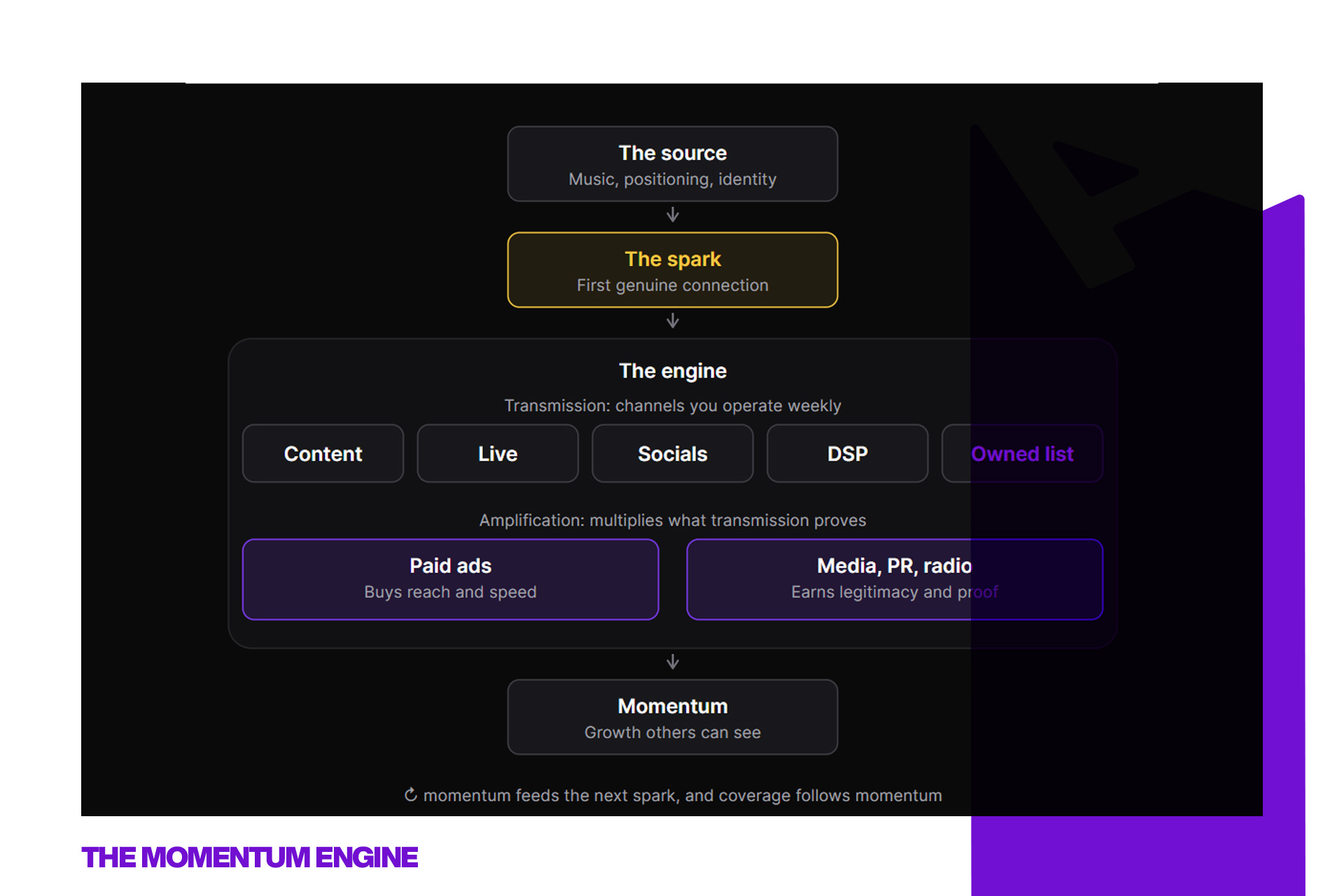
The Momentum Engine: how independent artists actually build momentum
Let's be real for a second. Nobody can hand you a blueprint to a music career. Anyone telling you they can is either mistaken or selling you something. Usually selling you something.
So this is not a blueprint. It's an engine diagram.
I'm Rich. I'm a musician who became a marketer, in that order. I've been in the van, played the empty Tuesdays, had the A&Rs come up from London and go home again. These days I run ad campaigns for independent artists, and the longer I do it, the more obvious one thing becomes: momentum doesn't come from one channel. It never has. You don't switch ads on and become a band people care about. Music careers are built across a whole spectrum of things, all turning together, each one feeding the next. A machine. An engine.
This guide maps that engine in ten parts, in the order they matter:
The source. The music, your positioning, who you are. Everything runs on this. The spark. The moment a stranger flips from "this was playing" to "who is this?" You can't buy it. You can detect it for free. The five channels you operate: content, live, socials, streaming, and the audience you own outright. This is the weekly work. The two amplifiers: paid ads and earned media. They multiply what the channels prove. They multiply nothing if there's nothing to prove. Momentum. What the whole thing produces: growth other people can see, in the numbers the industry actually checks.
Every part follows the same shape. The job, in one sentence. What you should already be doing, as habits, not hacks. The trap most artists fall into. The one number worth watching. And when, if ever, spending money makes sense.
Notice what that last bit means. I sell advertising, and advertising is Part 8 of 10. That's not an accident. Ads are an amplifier, and an amplifier pointed at silence just makes the silence expensive. Most artists who come to me don't need ads yet. Some of these parts will tell you not to hire people like me, and they'll be right.
Here's the other thing worth saying twice. Everything in this guide can be done for nothing. Everything in this guide can be done for nothing. One phone, some habits, a free email tool, and the willingness to look at your own numbers honestly. The engine doesn't run on budget. It runs on the spark, and on you turning the cogs every week whether you feel like it or not.
How to use them? Start with the source and the spark, because nothing downstream can fix a problem upstream. Then work through the channels and be honest about which cogs on your engine aren't turning at all. Every artist I've ever looked at has at least one that isn't. That's not a failure. That's just your to-do list, found.
One more thing. This guide is what I believe from twenty-odd years in and around this, but I'm not claiming they're the truth. They're conversation starters. If your experience says different, I want to hear it, because I'm happy to be proved wrong. That's how the ideas get better.
Table of contents
Right. Part 1. The source.
Part 1. The source.
The conversation nobody wants
I have this conversation more than any other, and it never gets easier to say. There's no easy way to say this, but if it's not working for you, it's probably the music. If it's not working, it's probably the music.
Not because your music is bad. That's the bit everyone gets wrong. The bar isn't "good". I've watched music I don't rate build real careers, and I've watched brilliant music die in silence. The bar is two other things entirely.
Finished to the standard your genre demands. Listeners forgive rawness instantly. They never forgive accidental-sounding. Line your track up next to the artists it would sit beside in a playlist. Does it sound like it belongs there? Rough is fine. Accidental is not.
Distinct enough to attach to. The most common failure I see isn't bad music. It's competent-generic music. Well played, well made, and interchangeable with a thousand other acts. There's nothing wrong with it, which is exactly the problem. There's nothing about it.
The source check
The source is the music, your positioning, and who you are. Work through these honestly. Every unticked box is a leak that no marketing can plug, mine included.
1. Your strongest track, chosen honestly. The one strangers react to, not the one the band loves most. Don't know which that is? Play three tracks to people who owe you nothing and watch their faces.
2. Finished to genre standard. See above. Next to your neighbours, does it belong?
3. Three to five reference artists, named without cringing. "We sound like X meets Y" isn't admitting you're derivative. It's giving people coordinates so they can find you. If naming references makes you squirm, the identity work isn't done yet.
4. The one-line answer, written down. You get asked "what do you sound like?" constantly, and most artists fumble it every single time. A settled answer is a marketing asset. Every fumbled version of that conversation is a fan lost at the door.
5. A visual world that agrees with the sound. Not a brand kit. Just consistency. Artwork, photos and videos that look how the music sounds.
6. The human element, found. What's actually true and interesting about you that you're willing to show? You don't invent an identity. You edit one. Find what's already there and commit to showing it.
7. Everything checked against everything. A dark, heavy record with cheerful meme socials confuses the exact people who would have loved you. Coherence is the cheapest fix in music. It costs nothing to make the pieces agree.
The trap
Polishing forever instead of answering the checklist. Another mix pass is rarely the missing piece. Distinctiveness and coherence usually are.
The test
Play your strongest track to a stranger. If they describe it afterwards as "the one with the...", you've got a source. If they say "it's good" and nothing else, keep working. It's got nothing to do with quality and everything to do with whether there's something to remember.
Part 2. The spark.
What it is
Years ago I wrote a song with a mate, and the lyric that arrived first, while we were bouncing round the room with guitars and a laptop, was "come on, little sparks matter". We were onto something bigger than we knew. Little sparks do matter. They're where everything starts.
The spark is the moment a stranger flips from "this was playing" to "who is this?" It's the smallest unit of momentum. Every channel in this engine exists either to produce more sparks or to multiply the ones you've already got. And two things about it are non-negotiable. You cannot buy it at any price. And you can detect it for free.
What a spark looks like
The tell is unprompted behaviour. Anything a listener does that costs them effort and that nobody asked for. In rising order of strength:
They come back. Repeat listens and saves. A save is someone voting to hear you again, and saves per listener is the cleanest early spark signal there is. It's sitting in your Spotify for Artists right now, and I'd bet you've never looked at it.
They dig. Profile visits after one track. Working through your catalogue. "Who is this" in the comments. Searching your name. Someone spending their own time to find out more about you is sparked, by definition.
They tell someone. Shares, tags, sending the link to a mate. This is the spark reproducing itself, and it's the difference between reach and growth.
They show up and they pay. A ticket bought by a stranger. A t-shirt. An email address handed over. Money and effort are the signals nobody fakes by accident.
The spark test
One question, answered honestly. Is anything happening that you didn't ask for and didn't pay for?
If yes, even at tiny scale (one venue that goes off, one comment section that lights up, one track whose save rate keeps climbing), your engine has something to work with. Your whole job becomes feeding that specific thing. More of that song's mood. More of that content. More of that room.
If no, the work goes back upstream to the source. The music, the positioning, or the match between them. And look, that's not failure. That's the cheapest diagnosis in music. Better to learn it now, for free, than after a marketing budget has broadcast the silence. I'd rather tell you that than take your money. Some marketers wouldn't.
The trap
Mistaking bought numbers for sparks. Purchased playlist streams, botted followers and boosted vanity views all look like activity and contain zero recognition. Worse, they bury your real signals in noise, so when a real spark happens you can't see it. Keep your data clean. It's the instrument you fly by.
The one number
Saves per listener, rising. Everything here lives in free dashboards, but if you only watch one thing, watch that.
When to spend
Not until this test passes. The spark test costs nothing to run. Release, gig, post, and watch for unprompted behaviour. Learn to recognise your own spark first, because every quid you ever spend on promotion is a bet that it exists.
Part 3. Content.
The job
Content is not posting. Content is how one spark ignites more than one person. A packed room reaches 150 people once. Footage of that packed room reaches people forever. Your content has three jobs, in this order: document the spark, show the human, carry the music.
The Nirvana thing
I got into music because of Nirvana coming through my sister's bedroom wall when I was thirteen. And the best piece of artist content I've ever seen is theirs: the Live! Tonight! Sold Out!! video. Here's the bit most people don't know. It wasn't conceived by a marketing executive or a label. It was Kurt Cobain's idea.
And what did it show? Two things. Rooms full of strangers absolutely losing their minds. And the band backstage, messing about, being idiots. If you've ever been in a band, you know that's half of what a band actually is. Proof of the spark, plus the human element. That's the whole formula, and it worked on me completely.
So no, you're not creating marketing content. You're letting your actual life as an artist be documented, then choosing what to show.
What you should already be doing
1. Film the room, not the stage. At every gig, someone films the crowd. A mate, a partner, a phone propped on the merch desk. Faces, movement, the moment the chorus lands. You already know what you look like. A stranger scrolling needs to see what it feels like to be there.
2. Phone on a tripod at every rehearsal. Not performing for it. Just running. The funny moment, the argument about the bridge, the take that finally works. That's a month of content you didn't have to think up, collected as a byproduct of being a band.
3. Capture the mess. The van. The load-in. The soundcheck disaster. The service station at 2am. The stuff you think is boring is the stuff that turns a track fan into a fan of you, and it requires no ideas and no editing skill. It requires being filmed while being yourselves.
4. One editing session a week. Ninety minutes, same day every week. Cut what you captured into three posts: one room moment, one human moment, one piece of the music itself. That ratio is deliberate. A feed that's all announcements and asks is a radio station that only plays adverts.
5. Post to a rhythm, not a mood. Three posts a week, every week, beats ten posts around release day and silence for a month. The algorithms need a steady flow to learn who your people are. And when a curious stranger taps your profile, they need a world to fall into.
The trap
Chasing trends. The occasional one that actually fits you? Fine. A feed of trend-chasing tells the exact people who would have loved you that you'll be anyone they like. And they can smell it.
The one number
Saves and shares per post. Not views. Not likes. A save is someone voting to see it again. A share is your spark reproducing itself. When a post earns those, you've found something. Make more of that.
When to spend
Never required here. But when you do eventually run ads, this habit is what feeds them. Whatever earns saves and shares organically is your pre-tested ad creative. You never have to guess, and you never pay to find out.
Part 4. Live.
The job
Live is the least scalable channel and the most valuable one, and I say that as someone who spent years in the van finding out. A room converts strangers into fans at a rate no screen can touch. Ticket sales are the one momentum signal nobody can fake. And a single gig, properly worked, feeds every other part of your engine in one night. You're not just playing shows. You're running engine events.
What you should already be doing
1. Pick rooms deliberately. The right thirty rooms beat a hundred thousand impressions. And support slots are the most underpriced asset in independent music. Think about what's actually on offer: someone else has gathered a room full of people who already like music adjacent to yours, and you get thirty minutes of their full attention. What would that cost as an ad campaign? You couldn't buy it. Chase the right bills, not the most bills.
2. Someone films the crowd at every show. Not the stage. The crowd. Faces, movement, the chorus landing. One good night of crowd footage is weeks of the exact content that proves your spark to people who weren't there.
3. Capture emails at the merch desk, every single night. A QR code, a signup sheet, a free sticker in exchange for an email. People who've just had the best night are at maximum willingness to stay connected, and that willingness lasts about one evening. Do the maths on a decent night: thirty strangers should become thirty emails and four clips. If the room disperses uncaptured, the gig stops paying the moment the lights come up.
4. Be the support act that gets asked back. Turn up on time. Keep to your slot. Help with the load-out. Big up the headliner from the stage. Bring whoever you can. Promoters book humans they like with acts that behave, and this costs nothing and compounds for years. I've seen careers built on being reliable and sound to work with. Honestly.
5. Track your own numbers. Every show: venue, capacity, tickets sold, how far out they sold. Agents and promoters keep this spreadsheet on you anyway. Keep your own, because "we sold out the same room faster each time" is a story you'll want to tell with evidence.
The trap
Saying yes to everything, and papering rooms to look busy. A badly placed gig in front of the wrong room costs a night and captures nothing. And a guest-list-stuffed "sell out" gets found out at the next, emptier, step up. Play fewer shows. Work them harder.
The one number
Tickets sold to strangers, and how far in advance. Twenty paid tickets in a town where you know nobody is the purest proof of momentum there is. Your mates in the room are lovely. They're not data.
When to spend
Fuel, a banner and a card reader before anything else. Show ads only make sense for a room you already have evidence you can part-fill: listeners in that city, previous sales, a support slot to convert. Ads can't make a town care. They can tell a town that already cares that you're coming.
Part 5. Socials.
Followers are not fans
Let's clear this up first, because the whole channel makes more sense once you have. A follower is someone who tapped a button once on ground you don't own. A fan is someone who'd cross a room, or a city, to hear you. This channel's job is to turn the first into the second, and the follower count itself tells you almost nothing about how that's going.
Content is what you make. Socials is where it lives and what happens around it. Three jobs: make you findable and instantly legible to a curious stranger, teach the recommendation algorithms who your people are, and hold the conversations that turn casual listeners into people who feel like they know you.
What you should already be doing
1. Audit your profile as a stranger. Open it in an incognito window and give yourself five seconds. Is it obvious what you are, what you sound like, and where the music lives? Does the grid look how the music sounds? Most first-contact moments convert or die on your profile, and I'd bet you've never once looked at your own shopfront the way a stranger does. Do it today. It's free and it takes five minutes.
2. Pick two platforms and go deep. The one where your genre's audience actually gathers, plus YouTube as the long-life archive. Two done properly beats five done thinly. Where do fans of your reference artists spend their time? Go there. Ignore the rest without guilt.
3. Fifteen minutes of engagement a day. Reply to every comment and DM, especially early on. The fan who gets a reply from the actual artist becomes an advocate, and at your size that intimacy is a superpower the big acts can't match. Then spend the rest commenting outward on adjacent artists, venues and scene accounts, because that puts your name in the exact comment sections where your future fans already are. Fifteen minutes a day. That's the whole growth tactic, and it costs nothing.
4. One pipe to your email list in the bio, always. A link offering a real exchange: an unreleased track, first dibs on tickets. Because here's the uncomfortable truth about this channel. It's rented ground. The algorithm changes, the reach gets repriced, accounts vanish. Its job is to continuously move people onto ground you own.
5. Post native, not broadcast. Same raw material, cut to each platform's grammar. Not one asset sprayed everywhere with the same caption. Platforms downrank obvious repurposing, and honestly, audiences can feel it too.
The trap
Chasing the follower number. The platforms themselves barely use it anymore. They show your content to non-followers when the early signals earn it, which means a small engaged audience beats a large passive one every single time. Teach the machine. The count takes care of itself.
The one number
Profile visits that become follows. Someone tapped through because something caught them, and what they found convinced them to stay. That's your content and your shopfront both working at once. Watch it weekly.
When to spend
Not here. Organic socials is the free testing lab that makes paid work later. Whatever earns saves and shares without spend is your proven ad creative. Spend fifteen minutes a day instead of five quid a day, and this channel gives you everything it's got.
Part 6. DSPs and playlists.
The job
This is where the moment of truth happens. A stranger presses play with intent, and either comes back or doesn't. Three jobs: turn first listens into repeat behaviour, teach the algorithm who your people are so it finds more of them for free, and generate the data the industry reads about you before anyone replies to your email. Because make no mistake, there are people looking at your data now instead of listening to your music. That's the world. Might as well know what they see.
What you should already be doing
1. Learn your ratios. Open Spotify for Artists and find two numbers: streams per listener and saves per listener. These are the truest measure of whether your music sparks, and almost nobody looks at them. Ten thousand streams tells you nothing. Ten thousand streams from two thousand listeners who keep coming back tells you everything. Totals are for bragging. Ratios are for knowing.
2. Pitch editorial properly, every release. The Spotify for Artists pitch is free and takes an hour to do well. Submit at least three weeks early. Name your genre coordinates and your reference artists without cringing. Tell the story in two sentences. And then treat it as what it is: a lottery ticket worth buying, never the plan.
3. Write ten personal pitches to real user playlists per release. Find actual curators in your niche. Real people, real listeners, playlists full of artists you'd sit beside. Short, personal, shows you've listened to their playlist. Ten placements on honest 2,000-follower playlists beat one placement on a farm, because those listeners arrive already halfway to caring.
4. Release to a calendar. A steady drumbeat of singles beats a yearly splurge. Every release restarts the machinery in your favour: Release Radar, a fresh pitch window, a reason to post, a reason to email. What you're building is a floor that rises with each cycle instead of resetting to zero.
5. Make release day an everything-day. Your email list asked to save (not just stream) in the first 48 hours. Content documenting the moment. Everything pointing at one date. Early saves and low skips teach the algorithm the track matters, and the algorithm is the only playlist that compounds.
The trap
Paying for playlist placement. If a playlist's owner asks for money before asking to hear the music, walk away. It doesn't matter how professional the site looks: what they're selling is bullshit, and worse than useless. Bought streams arrive with terrible skip rates and no saves, which wrecks exactly the ratios that matter, teaches the algorithm that people dislike your track, and gets seen through in about four seconds by anyone in the industry who checks. You'd be paying to look worse.
The one number
Saves per listener. A save is a stranger voting to hear you again. When that ratio rises release over release, you have momentum, whatever the totals say.
When to spend
Never on placements. If you ever run ads to this channel, optimise them for saves, not clicks or views, and only once your organic ratios show the music holds people. Paying to send strangers to a track that doesn't hold them is buying proof of the problem. I run ads for a living and I'm telling you that.
Part 7. Your owned audience.
The job
Every other channel has a landlord. Meta decides who sees your post. Spotify decides who hears your track. The venue decides who's on the bill. Email and SMS are the only channels where you hold the relationship directly, and that changes everything.
Three jobs: bank each spark before it evaporates, move your whole engine on command, and make the actual money. And on that last one, let's do the maths, because this is the part where the maths gets serious.
Say you spent two and a half grand recording your EP and two and a half grand marketing it. That's £5,000 to recoup. Through streaming, that's roughly 1.67 million streams, which for most artists is, let's be honest, not happening. Through direct-to-fan? About 125 fans. Fifty buying a t-shirt at 30 quid. Fifty buying tickets. Twenty-five buying a slightly nicer bundle. A hundred and twenty-five people. That's not a fantasy number. That's a village hall.
The list is where those 125 people live.
What you should already be doing
1. Set up the free tools this week. A free-tier email platform and one signup page. One evening, zero cost. Not having a list is the single most common leak I see: thousands of people reached every month, none of them kept. It's like playing a blinder of a gig and then setting fire to the guest book.
2. Offer a real exchange. Nobody joins a newsletter. People trade an email for something. The unreleased demo. First dibs on tickets. The acoustic version that lives nowhere else. Make the trade worth it and say exactly what it is.
3. Capture at every show. A QR code at the merch desk and a shout from the stage. People who've just had the best night are at their most willing to stay connected, and that willingness has a shelf life of about one evening. Bank it that night or lose it.
4. Send one honest email a month. Plain text. Written like you talk. From an address people can reply to. A story, something to hear or see, occasionally something to buy. And when someone replies, reply back. A two-line answer from the actual artist creates advocates at a rate nothing else on this list matches.
5. Keep SMS for the inner circle. Text opens are near-total, which is exactly why the channel burns fast. Email carries the relationship. Texts carry the rare moments that truly can't wait: the on-sale, the surprise drop. An artist texting like a brand is an unsubscribe machine.
The trap
Giving up because the numbers feel small. This channel grows in tens while socials grow in hundreds, and artists abandon it for that reason alone. Wrong comparison. A follower is a like on rented ground. A subscriber is a name, a deliverable address and a standing invitation. Thirty emails from a gig is that gig still paying out months later. Forty percent of your list will open what you send. Try getting that from an algorithm.
The one number
New subscribers per month. A list that adds people at every gig and release is alive at any size. A big list nobody's mailed in a year is a museum.
When to spend
Almost never necessary. The free tiers carry you to a thousand subscribers or more. Paid signup campaigns only make sense once the exchange demonstrably works organically, because ads can only amplify an offer people already say yes to.
Part 8. Paid ads.
Full disclosure
I sell ads for a living. Running paid campaigns for independent artists is the bread and butter of what I do. So understand what it means that this is Part 8 of 10, and that half of it tells you when not to hire people like me.
Here's why. Ads are an amplifier. They make an existing signal louder: more of the right strangers hearing music that already sparks, faster than organic reach can manage. They cannot create the spark. And pointed at music that isn't connecting yet, they amplify silence at your expense. I've audited enough ad accounts to tell you that most wasted spend in music isn't bad targeting or bad creative. It's good money pointed at no signal.
What you should already be doing
1. Pass the spark test before spending a penny. Is anything happening that you didn't ask for and didn't pay for? Unprompted saves, shares, strangers at shows, playlist adds by real people. If yes, ads can multiply it. If no, the money belongs upstream in the music, the content and the gigs, and this part can wait. It'll still be here.
2. Never guess creative. Your organic posting is a free testing lab. Whatever earned unprompted saves and shares is your pre-validated ad. Promote proof, not hunches, and you never pay to find out what works.
3. Start warm, tiny and single-minded. A fiver a day. Your best proven clip. Aimed at people who've already touched you: engagers, video viewers, your list. One campaign with one job. Cold audiences come later, and only once the warm ones prove the creative converts.
4. Optimise for spark actions, not noise. Saves, follows, signups, ticket clicks. The platform will happily sell you video views for a fraction of a penny, and they're worth roughly what they cost. If the campaign's result metric isn't something a future fan does, change it.
5. Judge ads outside the ads dashboard. While the campaign runs, did saves per listener rise? Did the list grow? Did organic reach climb? Amplification should leave the underlying signal stronger when it stops. If everything dies the moment the ads pause, you didn't amplify anything. You rented attention.
The trap
The boost button and the default settings. Boosting optimises for engagement the platform can sell you cheaply. Default placements quietly spend your budget in corners of the internet no fan will ever remember. I've seen accounts where 99% of the budget was leaking into junk placements and the dashboard still looked "cheap". Build campaigns properly or not at all, check where the money actually went, and treat suspiciously cheap results as exactly that. Suspicious.
The one number
Cost per spark action. What you pay for a save, a follow or a signup. It should fall as your creative and audiences sharpen. If it only ever rises, stop, and go back to the organic lab.
When to spend
Only after the spark test passes, and then as acceleration, not substitution. A small budget compresses time for an engine that already turns. Treat your first £150 as tuition. Its job is learning what converts, and a cheap clear lesson beats a slow expensive mystery.
Part 9. Media, PR and radio.
The job
This is the earned amplifier. Ads buy reach. Coverage earns legitimacy: the third-party validation no budget can purchase, the radio play that shows up on the industry's dashboards, the quote that strengthens every future pitch to promoters, playlisters and labels.
One thing to accept early, and it stings a bit. Coverage follows momentum. It doesn't create it. Nobody in press or radio wants to be first. Everybody wants to be early. I've watched this from both sides for years, and the pattern never changes: the journalists check who covered you already, the producers check what's happening around you. Your job is to make "early" visible and easy to say yes to.
What you should already be doing
1. Upload to BBC Introducing with every release. Free, legitimate, actually listened to, and a play is a permanent asset. I've watched Introducing support change the trajectory of artists I've known personally. This is the ground floor of earned media in the UK and there's no excuse for skipping it.
2. Pitch the story, not the song. Press doesn't cover "new single out now". Press covers the local band selling out the venue they used to sweep. The album written in a lighthouse. The scene growing around a night in your town. What's actually true and interesting about you? You did that work on Part 1. This is where it pays out. And local press with a local angle says yes far more often than you'd think.
3. Work the small stations. Community radio, student radio, specialist genre shows, internet stations with real listeners in your corner of music. They need music, they answer emails, they take chances. And airplay is airplay on the dashboards that matter.
4. Build your outreach list from evidence. Find five artists one step ahead of you in your lane and note every blog, station, playlist and YouTube channel that covered them. That list beats any media database you could buy, because everyone on it has already said yes to music like yours.
5. Be effortless to cover. A short bio, your one-line answer, two good photos, streaming links, all in one place, ready to send. Journalists and producers are drowning. The artist who saves them twenty minutes gets the slot. And keep an "as heard on" file, because every yes makes the next yes easier. Coverage begets coverage.
The trap
Paying for guaranteed coverage. Guaranteed placements, pay-to-play blogs, submission mills. This is the playlist farm in a different jacket: outlets with no readers, posts nobody sees, money spent to impress no one. Think it through for one second. If they'll guarantee coverage before hearing the music, what is the coverage worth? Exactly.
The one number
Coverage from outlets you'd actually read or listen to, plus airplay spins. Ten mentions on ghost blogs count for nothing. One play on a show your future fans trust counts for a lot. Quality of outlet beats quantity of mentions, every time.
When to spend
A PR or radio plugger becomes worth discussing when you have both a real story and momentum data to hand them. Hiring one before the spark test passes is paying a professional to amplify silence. And when the time does come, they'll do a far better job armed with your ratios, your ticket history and your "as heard on" file. Turn up with evidence and everything gets cheaper.
Part 10. Momentum.
What it is
Momentum is growth other people can see. And the music industry runs on it. There are people looking at your data now instead of listening to your music. I don't love that either, but pretending otherwise doesn't help you. Labels, promoters, playlisters and bookers are all risk assessors, and before any of them replies to your email they'll pull up your numbers and try to extend your trendline into the future. So let's look at exactly what they're looking at, because every bit of it is built by the engine you're already running.
What they actually check
Labels and scouts look at acceleration, not size. Three thousand monthly listeners growing twenty percent a month is more interesting than sixty thousand standing still, because flat means the story already happened. They check that several platforms are rising together. One line rising is a campaign. Three rising together is a fanbase. And they run the ratio checks: streams per listener, saves per listener, engagement per follower. One cooked number and they discount everything, including the true parts.
Promoters look at your ticket history in their city. Eight hundred listeners in Bristol supports a Bristol show. Eighty thousand worldwide doesn't. What size room did you fill, how fast, and do you visibly work your own gigs? Selling out a small room four weeks early beats half-filling a big one, because speed means demand beating supply, and that means headroom.
Playlisters and radio look at whether you'll hurt their numbers. Early skips, saves, completion, and whether anything's already happening around you. Nobody wants to be first. Everybody wants to be early.
What this means for you
A rising floor beats any spike. Does your baseline step up with each release, or decay back to where it started? Retention made visible is what everyone's really buying.
The unfakeable signals anchor everything. Tickets sold, emails opened, rooms filled, other people making videos with your music. These weigh most because they cost strangers money or effort. Everything else can be bought, and everyone doing the checking knows it.
Keep your data legible. Claim your profiles. Keep Spotify for Artists tidy. Record your gig numbers. Keep the "as heard on" file current. An artist with real momentum and messy data loses to an artist with modest momentum and a clean dashboard. That's unfair, and it's completely fixable, so fix it.
Don't pitch ahead of your data. The email to the agent lands when the Bristol cluster exists, not before. Everyone can verify everything now, which means a pitch is really just a cover letter for a dashboard. The engine's whole job is to make that dashboard undeniable before you ask anyone for anything.
The trap
Chasing a viral moment. Overnight success takes about ten years, according to most people who've had one. A spike that decays is an event, not momentum, and the industry can tell the difference at a glance. Consistency compounds. Lightning doesn't.
The one number
Three trendlines rising together. When your streams, your socials and your live numbers all point up at once, however small the numbers, you have the thing the whole industry is scanning for. And nobody gave it to you. You built it, one cog at a time, one spark at a time, one fan at a time.
That's the engine. Now go and turn it.
One last thing. If you read all ten and reckon your engine's turning, and you want a hand with the amplifier bit, that's literally what I do. Head to amplifyr.co.uk and start a campaign. If you read all ten and realised the spark isn't there yet, then this article just saved you some money, and honestly, I'd count that as a win for both of us.
And if you want all ten parts as a PDF to work through at your own pace, join the email list. Yes, that's me practising Part 7 on you. It works.